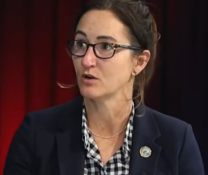
Days before the midterms a Minnesota election official sat down on Somali-language television and walked viewers through the simplest path to a ballot. Melanie Hazelip, the state’s voter outreach director, explained that anyone already registered can walk into an early-voting site with nothing in hand. She listed county offices, city halls, libraries and community centers. For those not yet registered she said an updated Minnesota identification card is enough, and if that is missing a list of other papers on the state website will still allow same-day registration. She never mentioned the one fact that separates a legal vote from a felony: United States citizenship.
BREAKING: MN official Melanie Hazelip just went on Somali TV explaining how Somalis could vote without IDs
They can even register same-day using a STATE ID FROM MINNESOTA
MN famously gives IDs to non-citizens https://t.co/EH1fmAaAzX
— End Wokeness (@EndWokeness) October 27, 2026
What the Rules Actually Require
Minnesota law still says only citizens may vote. The same law does not require anyone to prove that citizenship at the moment they register or cast a ballot. Registered voters need no identification at all. Same-day registration accepts a Minnesota driver’s license or state identification card. Those documents are issued to non-citizens under a 2023 law that carries no citizenship marking. A registered voter can also vouch for as many as eight other people who lack identification, signing an oath that they live in the precinct. The state’s own website lists citizenship as a requirement. Hazelip’s appearance simply never reached that sentence.
The Secretary of State’s office called the segment routine outreach and said the remarks described the rules for eligible voters. Critics noted the audience and the timing. Minnesota is home to roughly 107,000 people of Somali descent, the largest such community in the country. Census figures show most are now citizens, yet several thousand remain non-citizens, including permanent residents and a small number under temporary status. The same community has been at the center of large-scale fraud cases involving federal nutrition and Medicaid programs. In that setting the decision to detail the lowest-friction route to the ballot, while skipping the citizenship line, is hard to treat as an accident.
Why the Omission Matters on Tuesday
Early voting in Minnesota is already running well ahead of the last midterm. Minneapolis alone has accepted tens of thousands more ballots than at the same point in 2022. The open Senate seat is not a blowout. Polling averages show Democrat Peggy Flanagan leading Republican Michele Tafoya by roughly 4 to 7 points, a margin that can move with turnout in high-density urban precincts. The state’s House map contains several competitive districts in the Twin Cities metro where the Somali population is concentrated. Maximizing participation among a bloc that has leaned heavily Democratic in past cycles, while removing every practical reminder of the citizenship rule, is the kind of administrative choice that adds votes on one side of the ledger.
No one has produced a tape of Hazelip telling non-citizens to cast illegal ballots. She described the process the legislature and the current administration have put in place. That process treats proof of citizenship as something that can be checked later, if it is checked at all, and relies on an affirmation under penalty of law that few expect to be tested at scale. In a state that has already lost hundreds of millions to documented fraud, the same approach to the voter rolls is not a neutral technical detail. It is a choice about who is most likely to show up when the barriers are lowest and the reminders are fewest.
Tuesday’s results in Minnesota will not turn on this single appearance. They will turn on whether the final electorate matches the one the rules were written to encourage. When an official goes on community television days before the election and explains every easy step except the one that makes the vote legal, the practical effect is to enlarge the pool of ballots cast by the communities the majority party has worked hardest to register. That is not a mystery of the law. It is how the system is built.